Best Google Analytics Alternatives for SaaS Teams (2026)
Compare the best Google Analytics alternatives for small businesses and SaaS, with pricing, privacy, revenue tracking, and the quickest fit for your stack.

NoirTrack team·Follow

The best Google Analytics alternatives for small businesses and SaaS are tools that replace GA4 with simpler reporting, cleaner privacy defaults, and revenue proof that fits a lean team. The best Google Analytics alternatives for small businesses and SaaS teams usually want simpler reporting, cleaner privacy defaults, and proof of revenue, not a giant free platform. The best pick depends on whether you need revenue attribution, cookieless tracking, self-hosting, or product analytics depth. If you also want bot blocking before bad traffic reaches your numbers, NoirTrack is the most complete fit here.
Google Analytics is powerful, but many small teams do not need its depth or setup overhead. This guide compares the strongest GA alternatives for websites and SaaS by price, privacy, revenue tracking, and operational fit.
If you want one tool that tracks traffic, revenue, and blocked bot traffic, NoirTrack deserves a close look. After reading, you will be able to pick the tool that matches your stack, budget, and tracking needs.
Which Google Analytics alternative should you pick?
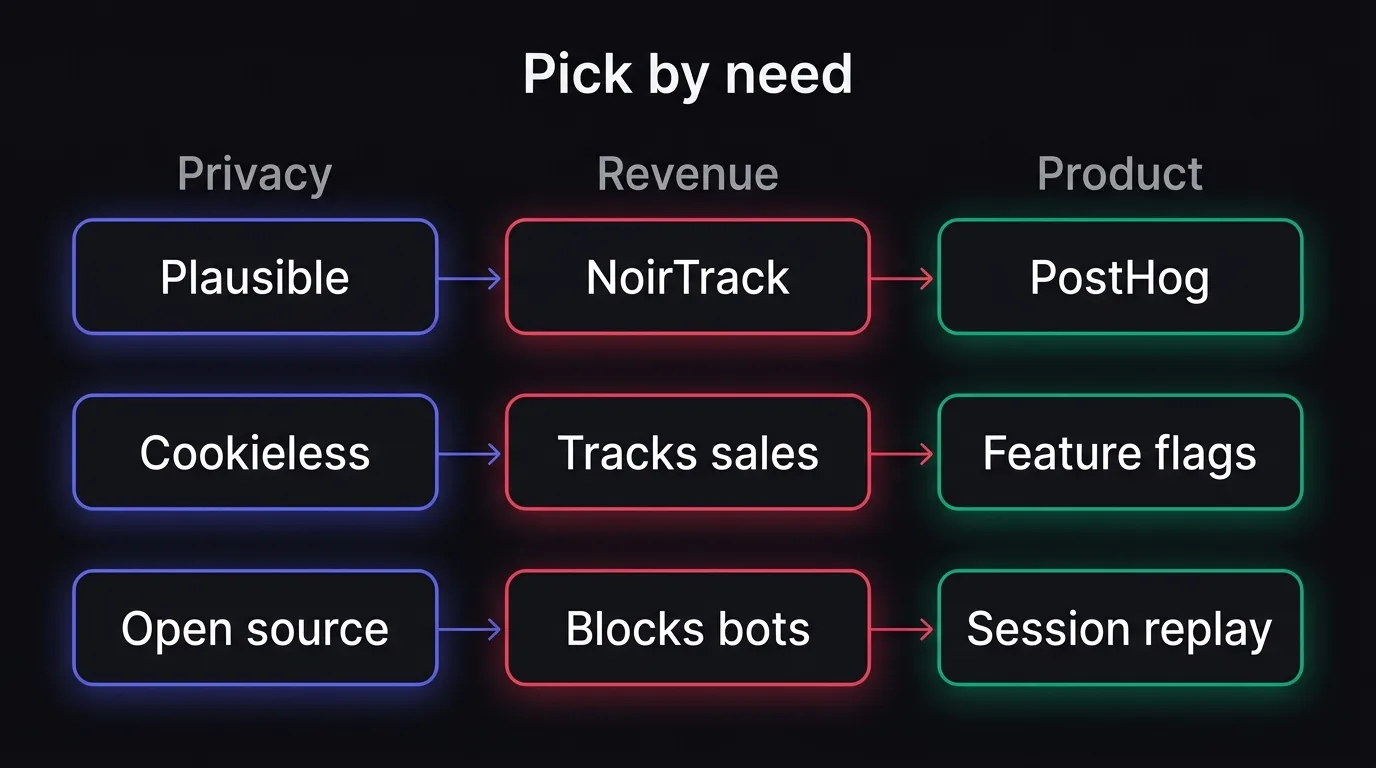
Pick the tool that matches your main job, not the one with the longest feature list. Website analytics buyers and product teams need different things: SaaS teams often care about revenue, funnels, and bot filtering, while content sites usually want privacy, a fast setup, and clear reporting. For a quick shortlist, use NoirTrack for revenue plus firewall, Plausible or Simple Analytics for privacy-first reporting, Umami or PostHog for open-source depth, and Fathom or Pirsch for lightweight analytics. If you want the best Google Analytics alternatives for small businesses and SaaS, start from that split.
Best fit by buyer type
Small business with sales should start with NoirTrack, because every plan includes revenue attribution and the firewall blocks bots before they reach the numbers. That matters when you need to know which channel brought a paid customer, not just a visit.
Privacy-first publishers and consultants fit Plausible or Simple Analytics better. Both are cookieless, so they keep tracking simple when you want to avoid banner work and keep the script light.
SaaS product teams usually get more from PostHog or Umami. PostHog adds product analytics, web analytics, session replay, feature flags, experiments, and surveys. Umami includes funnels, user retention, user journeys, and revenue tracking on every plan.
Where NoirTrack stands out
NoirTrack puts revenue attribution on every plan and matches each sale back to the visit, source, and campaign that brought it in. It also includes a firewall that blocks bots, scrapers, datacenter proxies, VPNs, and AI scrapers, so bad traffic does not shape the report.
It also has a cookieless mode with a rotating hash. Add data-cookieless to the script and analytics can run without a consent banner in that mode, because nothing is stored on the device.
That combination is a fit when traffic quality and source-to-sale attribution matter more than raw pageview totals. A simple setup can look like this:
<script defer src="https://noirtrack.com/t.min.js" data-site="YOUR_SITE_KEY" data-cookieless></script>
A SaaS team that gets 40 percent of signups from one paid channel can use that setup to separate real buyers from bot traffic and see which campaign paid back.
Google Analytics alternatives comparison table
Google Analytics 4 remains free, but small teams pay in consent setup, shorter retention on standard properties, and more work to tie revenue back to a source. The tools below make the trade-offs clearer for the best Google Analytics alternatives for small businesses and SaaS: some are built for clean website analytics, some add revenue, and some only filter bots in reports instead of stopping them before they count.
Comparison table
| Tool | Starting price | Free trial | Privacy/cookies | Revenue attribution | Bot blocking | Best for |
|---|---|---|---|---|---|---|
| NoirTrack | $9/month | 14 days on Pro | Cookie mode or cookieless mode | Yes, on every plan | Yes, firewall blocks bots before they count | SaaS teams that want revenue and cleaner traffic |
| Plausible | $9/month | 30 days | Cookieless | Yes, Business plan | No firewall listed | Privacy-first site analytics |
| Fathom | $15/month | 7 days | No cookie banners required | Yes | Filters bots in reports | Simple analytics with shared dashboards |
| Simple Analytics | $20/month | 14 days | No cookies | Not listed | No firewall listed | Teams that want very simple reporting |
| Umami | Free | Not listed | Open source, self-hostable | Yes | No firewall listed | Teams that want open-source analytics |
| Pirsch | $6/month | 30 days | Hosted in Germany | Not listed | No firewall listed | Low-cost analytics with long retention |
| PostHog | Usage-based, starts at $0.00005 per event | Not listed | Open source | Not listed here | Classifies bots at query time, does not block them | Product teams that want one platform |
| Google Analytics 4 | Free | Not listed | Uses cookies | Not built in without custom setup | No firewall listed | Teams already deep in Google Ads and BigQuery |
Prices checked 2026-10-06.
What to read from the table
NoirTrack starts at $9/month, includes revenue attribution on every plan, and adds a firewall plus cookieless mode. That matters if you want one setup for traffic, sales, and bot control. See how revenue tracking works and how the firewall works if you want the mechanics.
Plausible and Simple Analytics are the cleanest privacy-first choices. Plausible is open source and self-hostable, and both avoid cookie banners in normal use, but neither lists a bot-blocking firewall. If you only want pageviews and a low-friction dashboard, they fit well.
GA4 is still free, and that keeps it attractive for teams on a tight budget. The trade-off is consent work, 2 or 14 months of retention on standard properties, and more setup for revenue attribution. It also does not give a small team the same out-of-the-box revenue and bot-blocking workflow.
What do Google Analytics alternatives cost in 2026?
Pricing in 2026 comes down to one buyer question: what is the cheapest plan that still covers your site, your team, and the numbers you need to read? Checked on 2026-10-06, the lowest entry price is not always the lowest real cost, because some tools charge by pageviews or events while others move funnels, revenue, teams, or history into higher tiers.
Starting prices and trial terms
NoirTrack starts at $9 on Starter, $19 on Pro, and $49 on Business, with a 14-day free trial on Pro and revenue attribution on every plan. That matters if you care about which traffic pays from day one, because you do not have to wait for a higher tier to see revenue.
Plausible starts at $9 with a 30-day free trial and no card required. Its Business plan adds revenue attribution and funnels, so the cheapest plan works for basic traffic reporting, while paid upgrade tiers cover money reporting.
Fathom starts at $15 with a 7-day free trial and card required. Revenue tracking and automatic bot filtering are included on every plan, so the main trade-off is the pageview cap, not a feature gate.
A simple scenario shows how the price gap can widen. If you run one SaaS site with 300,000 monthly pageviews, $9 is not the full story when the cheaper plan leaves you without revenue attribution or funnels.
When the cheapest option is not the best value
GA4 is free, but small teams often pay in setup time. You still need to configure consent, define events, and build revenue workarounds if you want subscription or checkout data in one place. Google documents the free standard tier, and its own help pages note that retention settings are limited on standard properties.
If you sell subscriptions or digital products, the real cost is bad attribution, not the plan price. A tool that counts visits but cannot tie a sale back to the source leaves you guessing which channel deserves more budget.
If bot traffic is a problem, a tool that only filters bots in reports can still leave inflated numbers in your raw counts. NoirTrack blocks bad traffic before it reaches your numbers, which is different from report-time filtering. See how revenue tracking works and how the firewall works for the setup path.
Which tool is strongest for privacy, revenue, or product teams?
The best Google Analytics alternatives for small businesses and SaaS teams split into three jobs: privacy-first site measurement, product analytics, and revenue tracking. If your team cares most about consent, self-hosting, and open source, pick one of the privacy tools. If you need experiments and feature work, pick a product platform. If you want to see which traffic makes money and stop bot traffic before it hits your numbers, NoirTrack is the better fit.
Privacy-first website analytics
Plausible is the strongest choice for open source, self-hosting, EU ownership, and cookieless analytics. It suits teams that want public code and control over where the app runs. Simple Analytics fits teams that want no cookies, a free starter tier, and unlimited history on the self-serve plan. Fathom works well when you want a lighter hosted tool with shared dashboards and no cookie-banner requirement.
These tools focus on clean website metrics. They do not try to be full product suites, and that is the point. If your main job is publishing content, measuring traffic, and keeping setup simple, they stay out of the way. If you want to run cookieless tracking in NoirTrack, you can add data-cookieless and use a daily-rotating hash.
SaaS and product analytics
PostHog is the strongest option for engineering-heavy teams that need product analytics, feature flags, experiments, surveys, and session replay in one place. It is open source and built for teams that will spend time on setup because they want a broader product stack. Umami is the stronger open-source pick if you want funnels, retention, user journeys, and revenue tracking, with self-hosting available.
NoirTrack is the better pick when marketing traffic, revenue attribution, and bot blocking matter more than product experimentation. It ties sales back to the visit that brought them and blocks bots, scrapers, datacenter proxies, VPNs, and AI scrapers before they reach your numbers. If a SaaS team cares about channel quality, a Stripe sale from a paid search click shows up as revenue from that source, which is the decision most founders need.
For teams choosing by trade-off, the split is simple: use Plausible, Simple Analytics, or Fathom for privacy-first web stats; use PostHog or Umami for deeper product work; choose NoirTrack when you need traffic quality and revenue attribution first.
How do you choose the right alternative for your stack?
Choose the tool that matches three things: how hard it is to install, whether you need cookie-free tracking for compliance, and whether you care more about revenue attribution or clean traffic data. If you need the best Google Analytics alternatives for small businesses and SaaS, start with the stack you already run, then check whether the tool can track paid visits and preserve your Google Analytics history. If you are switching, import your Google Analytics history first so you keep last year's context instead of starting at zero.
Choose by setup path
- Static site or CMS. Use the one-line script tag if you want the fastest path. A plain install looks like this:
<script defer src="https://noirtrack.com/t.min.js" data-site="YOUR_SITE_KEY"></script>
-
Next.js, React, Vue, SvelteKit, Astro, Laravel, or Django. Use the framework guide or the npm SDK when the site is already split across frontend and backend code.
-
AI-built app or agent-written codebase. Use the AI setup prompt if you want the agent to wire the tracker into the project for you.
Choose by compliance and traffic quality
If you need cookie-free analytics, NoirTrack cookieless mode stores nothing on the device, so most sites can skip the analytics consent banner. Read the setup details in GDPR & cookieless.
If bot traffic distorts your reports, NoirTrack firewall blocks bots, scrapers, datacenter proxies, VPNs and AI scrapers before they reach your numbers. The firewall is on by default in Monitor mode first, then you switch to Block mode when you are ready. See how the firewall works.
If your main need is keeping old GA history, use the Google Analytics import path before you cut over. The import is additive, so live tracking keeps collecting while old data lands in the dashboard.
What should you do next after choosing a tool?
Install the snippet first, import old history if you need it, and verify one revenue or goal event before you move traffic over. If you picked NoirTrack, start with the quickstart, then turn on revenue attribution and the firewall if bad traffic is a problem.
A simple rollout order
- Install. Add the snippet.
- Connect revenue. Wire up sales tracking so source data works from day one.
- Turn on the firewall. Start in Monitor mode, then switch to Block mode once the traffic looks right.
What to check in week one
Check that bot traffic drops out of visitors and pageviews. Compare sources, campaigns, and sales against your old GA data.
Install, verify, compare a week of numbers, then switch fully.
Questions, answered.
NoirTrack is the best fit for a small business that wants revenue attribution and bot blocking in one tool, while Plausible and Simple Analytics fit teams that want privacy first reporting. Fathom is a hosted service with no cookie banners required and event and revenue tracking. The better pick comes down to the job you need done, not the lowest sticker price.
The software cost can be free with GA4, while paid alternatives usually start around $9 to $20 per month for small sites. Switching cost is mostly the work to install the new tag, set up events, and import history if your new tool supports it. The time cost is often higher than the software cost.
Plausible and Simple Analytics are the clearest privacy first picks because both are cookieless and say no consent banner is needed. NoirTrack also offers cookieless mode with a daily rotating hash, which avoids a consent banner for analytics, while its default cookie mode uses one first party cookie for exact returning visitors. That gives you a privacy first option and a more exact mode in the same product.
NoirTrack tracks revenue attribution on every plan and supports Stripe, Paddle, Polar, Lemon Squeezy, Dodo Payments and Creem. Other tools vary more: DataFast supports Stripe, LemonSqueezy, Polar and Shopify, Fathom includes event and revenue tracking, Plausible includes ecommerce revenue attribution on Business, and Umami includes revenue tracking on every plan. Some tools do not list direct payment provider integrations.
The biggest mistake is choosing on price alone and ignoring bot traffic, consent, and revenue attribution. A cheap tool can look bad if bots inflate visits, consent banners block measurement, or you cannot tie visits to sales. The safer move is to check what you need to measure, then pick the tool that matches that job.
Try NoirTrack
See which traffic actually pays.
Analytics with revenue attribution and a built-in bot firewall. One script tag, live in two minutes.
Free 14-day trial, no credit card
Written by NoirTrack team
The privacy-first Google Analytics alternative with a built-in bot firewall and revenue attribution. See which traffic makes you money, no cookie banner.


