DataFast Alternatives for Revenue-Focused Analytics in 2026
Compare DataFast alternatives for teams that want revenue attribution, privacy-friendly tracking, and enough bot protection to trust the numbers.

NoirTrack team·Follow

If you want revenue attribution first, NoirTrack is the strongest fit because it ties each sale to the visit that brought it and blocks bots before they reach the numbers. DataFast alternatives are other analytics tools you can switch to when you want different trade-offs in pricing, privacy, bot handling, and setup. If you mainly want a lighter website analytics tool, Plausible, Fathom, Simple Analytics, or Umami can be simpler. DataFast is still a good pick when you want its mobile app and purchase-likelihood prediction features.
DataFast is useful when you want revenue-aware analytics, but different teams need different trade-offs around pricing, privacy, bot handling, and setup. This post compares the main alternatives so you can choose based on what matters most: sales attribution, clean traffic data, and how much infrastructure you want to manage. It also shows where NoirTrack is a better fit for teams that want revenue numbers they can trust, not just visitor counts. After reading, you will know which tool fits your site, budget, and reporting goals.
THIS IS A COMPARISON POST. Readers are choosing a tool and will check what we say, so:
- Every claim about any product, ours included, comes from the CHECKED FACTS below. Never add a price, limit or feature from memory. If the facts don't say whether a tool has something, say nothing about it.
- "Not listed" means the tool's own pricing page doesn't mention it: write "doesn't list X" or leave it out, never "doesn't have X".
- Be fair. Say plainly who each tool suits better, including when a competitor is the better pick (for example self-hosting, a free plan, or an EU-owned company). A one-sided post reads as an ad and earns no trust.
- Title patterns that rank: "NoirTrack vs X (2026):
" for one rival, "X alternatives (2026): " or "Best tools for (2026)" for a roundup. Put the year in the title. - Sections: the short answer (who should pick which), a comparison table (features and starting price), pricing compared with the date the prices were checked, where each tool is stronger, how to choose, then the next step. A roundup gives each tool its own H3 with what it is, best for, starting price and the trade-off.
- The FAQ answers the questions buyers ask: price, switching, privacy and cookies, revenue tracking.
Which DataFast alternative should you pick?
Pick the tool that matches the job. If you need revenue attribution tied to visits, bot blocking before bad traffic reaches your numbers, and a privacy-first setup, NoirTrack fits best. If you want lightweight website analytics and can skip direct payment-provider attribution, Plausible and Simple Analytics are the cleaner fit. If you need product analytics plus replay, flags, experiments, and surveys in one place, PostHog is the better match. For teams already deep in DataFast, the question is whether you want to keep its revenue workflow or move to a stack that blocks bots before they distort reporting.
Pick by primary need
| Primary need | Best fit | Trade-off |
|---|---|---|
| Revenue tied to the visit | NoirTrack | Hosted only, no self-hosting |
| Lightweight website analytics | Plausible or Simple Analytics | No direct payment-provider attribution |
| Product analytics in one platform | PostHog | More setup and concepts |
| Keep a revenue-centric DataFast setup | DataFast | No listed firewall for blocking bots |
NoirTrack is the best fit when you need revenue accuracy and bot blocking together. The firewall blocks bots, scrapers, datacenter proxies, VPNs and AI scrapers, and revenue attribution links each sale back to the visit that brought it. Cookieless mode is available when you want analytics without a cookie banner. See /docs/revenue-attribution and /docs/firewall.
Plausible and Simple Analytics make sense when you want plain website analytics with less setup and no direct payment-provider work. Plausible starts at $9 per month for 10,000 pageviews, and Simple Analytics starts at $20 per month. Both are hosted services, and both skip the payment-linking work that revenue teams need.
PostHog suits product teams that want analytics, replay, feature flags, experiments and surveys in one tool. That is useful when product work drives the roadmap and you want one place for usage and experiments. It is more complex than a website analytics tool.
When DataFast still fits
DataFast still fits if you want its mobile app, MCP access, cross-domain tracking, and purchase-likelihood style workflow. It also makes sense if your team already depends on its Stripe, Lemon Squeezy, Polar or Shopify integrations. If your main need is bot blocking, use another tool. DataFast does not list a firewall, so it will not stop bad traffic before it reaches your reports.
A simple migration check looks like this: if you need a firewall that blocks bots, scrapers, datacenter proxies, VPNs and AI scrapers, pick NoirTrack; if you only need pageview reporting, Plausible or Simple Analytics is enough; if you need product analytics, choose PostHog.
How do the main alternatives compare on price and features?
The lowest-priced plans start at the same $9 point for NoirTrack, DataFast alternatives like Plausible, and a few others, but the buying decision changes fast once you care about revenue attribution, bot blocking, or self-hosting. Prices below were checked on 2026-10-06 and are listed as posted, so you can compare starting points without guessing.
Comparison table
| Tool | Starting price | Trial | Revenue attribution | Bot blocking | Notes |
|---|---|---|---|---|---|
| NoirTrack | $9 | 14-day trial | Yes, on every plan | Yes, firewall blocks bots before reporting | Also includes uptime, AI analyst, and cookieless mode. |
| DataFast | $9 | 14-day trial | Yes, focused on paying customers | Not listed | Adds mobile app, API/CLI/MCP, and purchase-likelihood features. |
| Plausible | $9 | 30-day trial | Yes, on Business | Not listed | Open source, self-hostable, EU-hosted, cookieless. |
| Fathom | $15 | 7-day trial | Yes | Filters bots in reports only | No funnels or firewall listed. |
| Simple Analytics | $20 | 14-day trial | Not listed | Not listed | No cookies, EU-based, unlimited history on paid plan. |
| Umami | Free | Free plan | Yes | Not listed | Open source, self-hostable, funnels and revenue tracking included. |
| GA4 | Free | None listed | Not built in | Not built in | Strong with Google Ads and BigQuery, but cookie consent is usually required. |
A quick example: if you want $9 entry plus blocked bot traffic before it lands in your numbers, NoirTrack is the cleaner fit. If you want open source and self-hosting, Plausible or Umami fit better. If you want a free start and can live without built-in payment attribution, GA4 is still the baseline.
For setup help, see /docs/quick-start and /docs/revenue-attribution.
What makes NoirTrack stronger for revenue-focused teams?
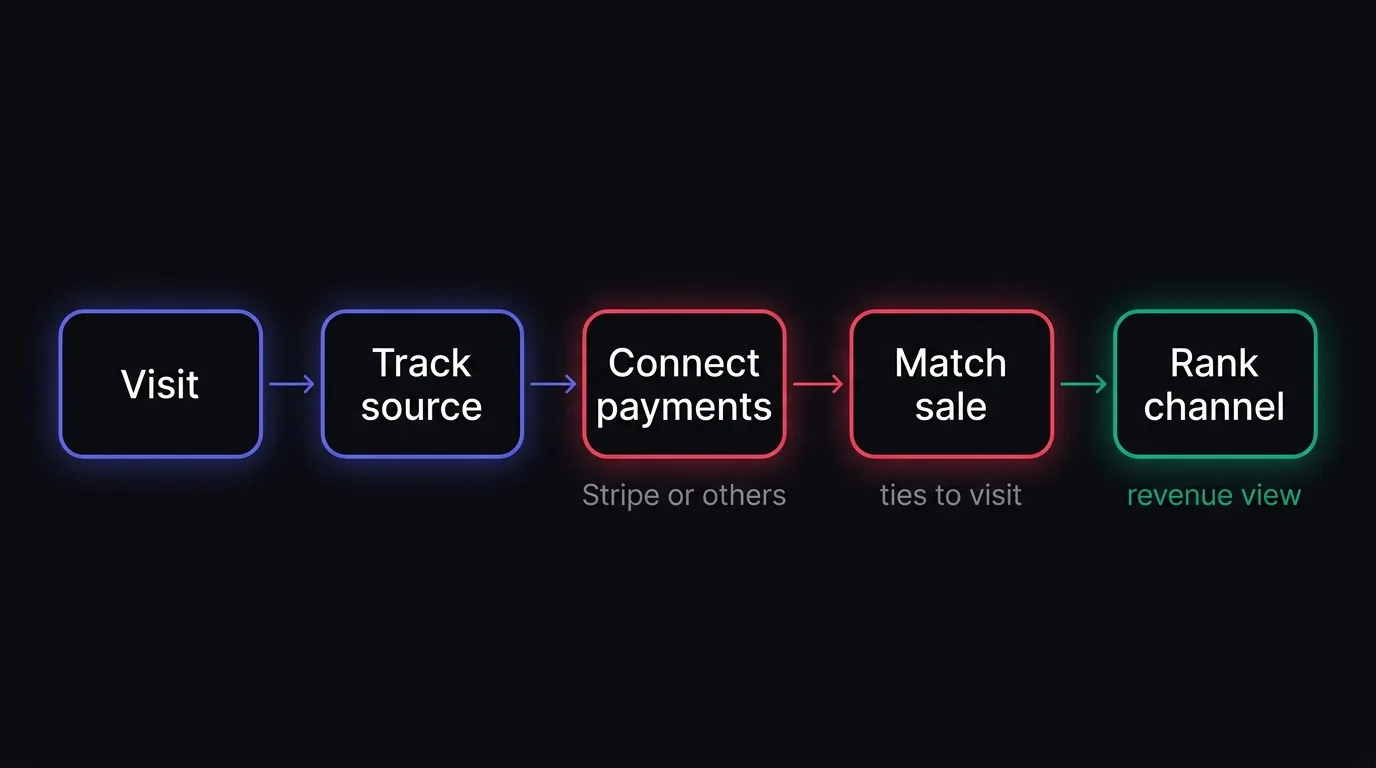
NoirTrack is stronger when you need revenue attribution and bot blocking in the same setup. It links each sale back to the visit, source, and campaign that brought it in, while the firewall keeps bots, scrapers, datacenter proxies, VPNs, and AI scrapers out of the numbers. That matters for teams that want to compare channels by money earned, not by raw visits. If you are evaluating DataFast alternatives, this is the split that changes the day-to-day workflow: one system records the sale, the other keeps bad traffic from warping the report.
Revenue attribution plus firewall
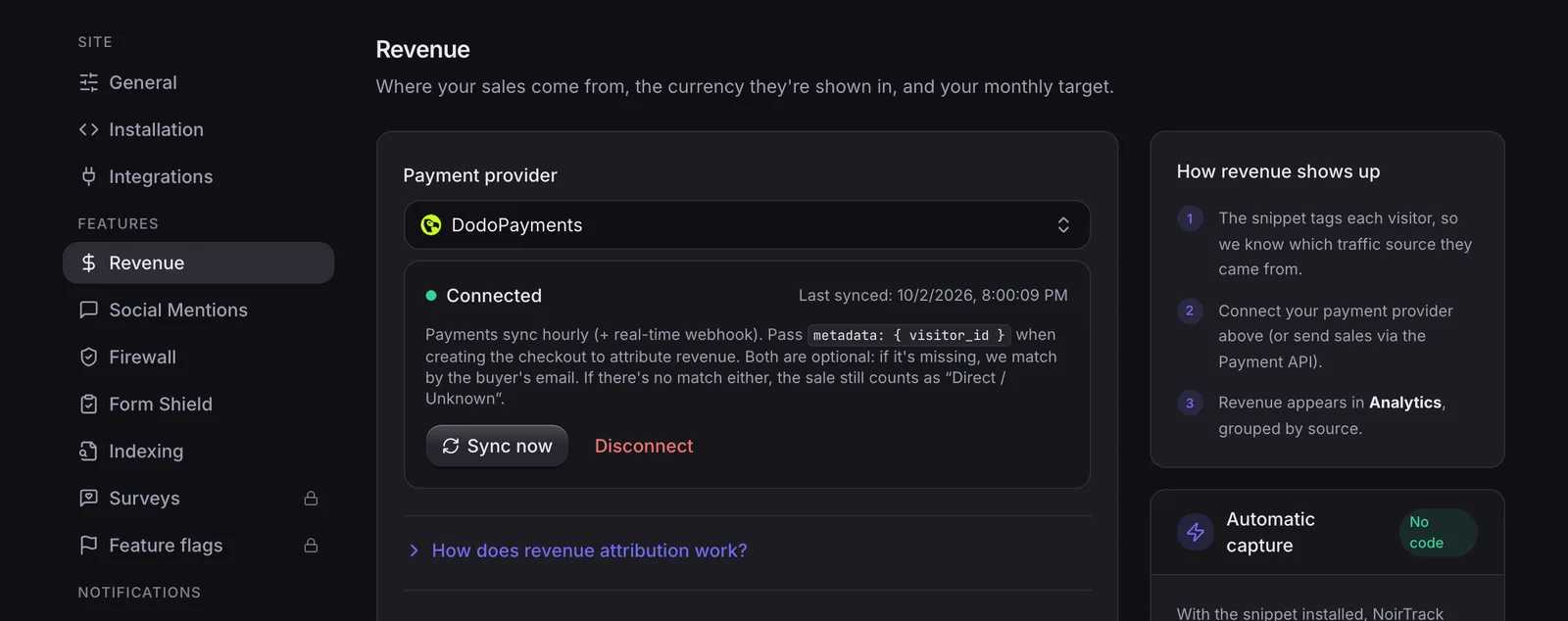
NoirTrack attributes revenue on every plan and supports Stripe, Paddle, Polar, Lemon Squeezy, Dodo Payments, and Creem. The matching flow is direct: connect a provider once, then NoirTrack ties sales back to the visitor that caused them. You can start the firewall in Monitor mode, then switch to Block mode when you are ready to enforce. That means you can watch what would be blocked before you turn it on.
A practical setup looks like this: add the tracking script, connect your payment provider, then set the firewall mode in the dashboard. In /docs/firewall, the client-side path uses one script attribute, and new sites start in Monitor mode by default. If a paid campaign brings 1,000 visits and 40 sales, the revenue report and the firewall are reading the same traffic pool, so the channel ranking stays tied to real buyers instead of junk traffic.
NoirTrack also gives you revenue tracking details if you want the matching order and provider list in one place.
Importing from DataFast
If you already have history in DataFast, NoirTrack can pull it in through the API instead of asking you to start fresh. The import uses your DataFast website key, which starts with df_, and it brings over daily visitors and pageviews for your site history. That preserves past reporting context while you move to a setup that includes revenue attribution and firewall protection.
The import flow is short:
- Get the website key in DataFast under Website settings → Developer.
- Open Site → Settings → Import in NoirTrack.
- Paste the key into the DataFast card and click Import history.
The key is used once and then discarded, so you can revoke it in DataFast right after the import. That makes the switch clean for teams that want old charts to stay comparable while they change tools.
If you want the setup steps in order, start with the quickstart and then move to From DataFast.
Where do the competitors beat NoirTrack?
Some DataFast alternatives fit better when your team cares more about open source, self-hosting, or product analytics than revenue-first website analytics. NoirTrack is built around revenue attribution and bot blocking, but several rivals are the better call if you want a cheaper entry point, a broader analytics suite, or a tool your engineers can run themselves.
Competitor strengths at a glance
| Tool | Strongest fit | Starting price | Trade-off |
|---|---|---|---|
| Plausible | Open-source, self-hostable, EU-owned, cookieless website analytics | $9/month | No payment-provider attribution or firewall |
| Fathom | EU data isolation and simple reporting with saved views | $15/month | Filters bots in reports, but does not block them |
| Umami | Open source and free self-hosting | Free self-hosted, $20/month managed | No payment-provider integrations or firewall |
| PostHog | Product analytics suite for engineering and product teams | Usage-based, starting at $0.00005 per analytics event | More setup and more concepts than a simple website tool |
| GA4 | Google Ads, BigQuery, and enterprise analysis | Free for standard properties | Needs more setup and usually a consent banner |
Plausible stands out if you want a public codebase and the option to host it yourself. Fathom suits teams that want straightforward web analytics, EU data isolation, and shared dashboards without extra product layers. Umami is the low-friction self-hosted pick. PostHog is a better fit when your team wants funnels, experiments, sessions, and feature flags in one place.
Best-fit trade-offs
- Pick GA4 when your stack already runs on Google. GA4 ties into Google Ads and BigQuery, and that matters if your reporting lives there.
- Pick Simple Analytics when you want cookie-free reporting and little setup. It keeps the focus on pageviews and simple reporting, but it does not list revenue attribution or bot blocking.
- Pick Plausible or Umami when open source matters more than a managed bundle. Both give you a path to self-hosting, which some teams need for policy or control.
- Pick Fathom when you want simple dashboards with EU data isolation. A newsletter site with 200,000 pageviews a month can start at $25/month on Fathom, while a team that needs purchase credit should look elsewhere.
- Pick PostHog when your product team needs more than website analytics. A checkout funnel plus experiments and feature flags is a different job from ranking traffic by revenue.
If you are comparing DataFast alternatives for a revenue-led site, the deciding line is usually this: choose the tool that matches your reporting job, then pay only for the parts you will use.
How should you choose the right analytics stack?
Pick the stack by the job you need it to do. A website tool tracks visits and sources, a product tool tracks in-app behavior, and a revenue system ties traffic to sales. Start with the outcome you care about, then compare the tools that can actually deliver it. For teams sorting through DataFast alternatives, the right choice usually comes down to whether revenue attribution, bot control, privacy, or product analytics matters most.
Use this decision checklist
- Start with revenue. If you need to see which source, campaign, or page led to a paid order, keep NoirTrack and Fathom on the list. NoirTrack links every sale back to the visit, source, and campaign that brought it, and it connects to Stripe, Paddle, Polar, Lemon Squeezy, Dodo Payments, and Creem.
- Check traffic quality next. If you want bad traffic stopped before it reaches your reports, NoirTrack is the clearest fit because its firewall blocks bots, scrapers, datacenter proxies, VPNs and AI scrapers. The setup can be one snippet attribute on the client side or a server-side guard.
- Match your privacy bar. If open source, EU hosting, or self-hosting matters more than payment tracking, Plausible or Umami may fit better. If you want no cookies and no consent banner, Fathom, Plausible, Simple Analytics, and Umami all take that path in different ways.
- Check setup cost. A team that only needs website analytics may prefer the shortest install. A team that wants revenue plus bot blocking may accept a bit more setup because it replaces two separate tools.
Use this decision checklist
A practical test is to map one real source to one real sale. For example, if your paid search campaign brings 20 orders a month, a revenue system should show those orders in the same report as the traffic source, not leave you guessing with pageviews alone. If it cannot do that, it is the wrong tool for this job.
Choose by team type
Founders and marketers usually want one place to read traffic, sources, and sales, so a revenue-first stack saves them from stitching together three reports. Developers often pick PostHog or GA4 when they need product events, experiments, or BigQuery-style workflows that go beyond website analytics. Teams moving from DataFast should compare the import work against what they gain from stronger bot blocking and direct payment attribution. If that path matters, see the DataFast import steps and the revenue attribution setup.
What is the fastest next step if you are switching?
The fastest next step for DataFast alternatives is to import your history, install tracking, and confirm revenue before you compare dashboards. Start with the DataFast import flow, which imports your DataFast history. Then add the script from the quickstart so new traffic lands in NoirTrack right away. After that, connect your payment provider in Revenue and check that sales match the visits you expect.
Migration order
- Import history. Bring over the daily DataFast data first.
- Install tracking. Paste the snippet on your site or app.
- Connect payments. Turn on revenue attribution.
- Watch bots. Keep the firewall in Monitor mode.
- Block cleanly. Switch to Block mode after you review false positives.
Questions, answered.
NoirTrack is the strongest fit if you want revenue attribution tied to visits plus bot blocking before the numbers are recorded. NoirTrack ties each sale to the visit that brought it, and its firewall blocks bots, scrapers, datacenter proxies, VPNs and AI scrapers before they reach your analytics. Umami and Plausible can work if you want revenue features but do not need a firewall. DataFast is still a good choice if you want its own workflow, purchase likelihood prediction, and product oriented extras.
DataFast supports an API, CLI and MCP access, plus cross domain and subdomain tracking. The switch is usually about reconnecting tracking and payments, then checking that bot blocking and revenue attribution match what you expect. DataFast also supports cookieless tracking and cross domain tracking, so the switch is usually about preserving your setup rather than rebuilding your whole reporting model.
Plausible and Simple Analytics are the clearest privacy first options, and both are cookieless. Plausible is open source and self hostable, and Simple Analytics does not use cookies or need a consent banner. NoirTrack also offers cookieless mode for analytics, with a daily rotating hash and no consent banner needed for analytics. Cookie mode is available if you want exact returning visitors, and NoirTrack includes a built in consent banner for that setup.
NoirTrack does, because its firewall blocks bots, scrapers, datacenter proxies, VPNs and AI scrapers before they hit the numbers. Visitors and pageviews exclude bots, and Monitor mode lets you inspect traffic before switching to Block mode. Fathom and PostHog can filter bot traffic in reports, but that is not the same as blocking traffic at the edge or in the app. Filtering changes what you see after the fact, while a firewall stops bad traffic before it lands in your analytics.
The usual mistake is choosing a clean dashboard without checking whether bad traffic, spam, or missing payment attribution will still distort the result. A tool can look simple and still leave you with noise in the data or no link between visits and revenue. If you care which traffic makes money, check that the tool connects revenue and handles bot noise before you compare screenshots. That matters more than a polished interface when the goal is revenue focused analytics.
Try NoirTrack
See which traffic actually pays.
Analytics with revenue attribution and a built-in bot firewall. One script tag, live in two minutes.
Free 14-day trial, no credit card
Written by NoirTrack team
The privacy-first Google Analytics alternative with a built-in bot firewall and revenue attribution. See which traffic makes you money, no cookie banner.


