Plausible alternatives with revenue attribution in 2026
Compare privacy-first Plausible alternatives that tie visits to revenue, so you can pick the right tool for attribution, bots, and tracking.

NoirTrack team·Follow

If you want Plausible-like privacy analytics plus direct revenue attribution, NoirTrack is the strongest fit because it ties sales to the visit that brought them and includes bot blocking. Plausible alternatives with revenue attribution are analytics tools that track sales back to the visit that brought them. Plausible and Fathom are simpler analytics-first picks, while Umami and PostHog suit self-hosters and product teams. If you need open source or self-hosting, NoirTrack is not the right choice.
Plausible does not center payment-provider revenue attribution, so the first question is whether you need simple traffic reporting or direct sales tracking. The right choice depends on whether you want simpler reporting, open source, self-hosting, or direct revenue tracking from paid traffic. This guide compares the tools that actually help you see which traffic turns into money, not just visits, so you can pick the tool that fits your site and your payment stack.
Which Plausible alternative has revenue attribution?
Plausible alternatives with revenue attribution are the tools worth checking when you need to tie source and campaign to money, not just visits. NoirTrack is the best direct pick for that job because it links each sale back to the visit that brought it and does that on every plan.
Best pick by use case
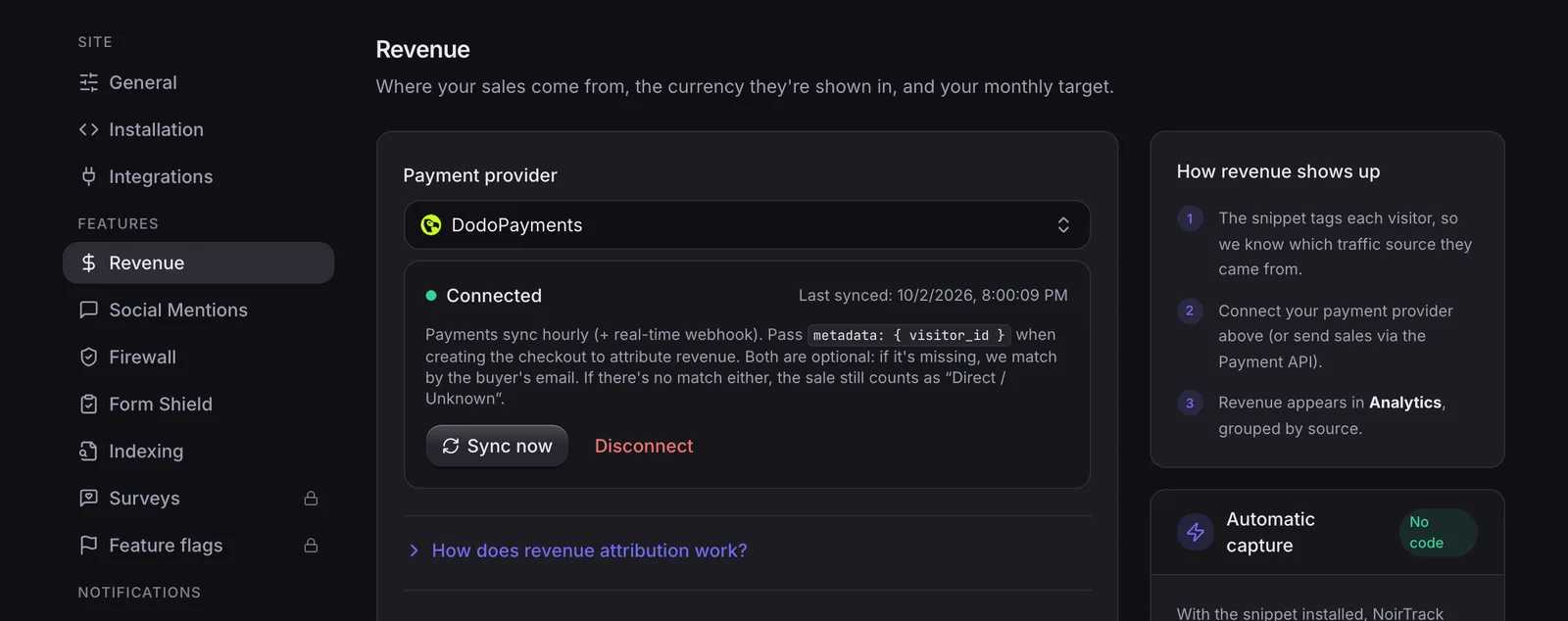
NoirTrack fits teams that want revenue attribution on every plan, built-in bot protection, and a privacy-first analytics dashboard. It connects Stripe, Paddle, Polar, Lemon Squeezy, Dodo Payments, or Creem, then matches each sale back to the visitor, source, and campaign.
Plausible fits teams that want open source, EU ownership, cookieless analytics, and can live without payment-provider attribution. It includes ecommerce revenue attribution on its Business plan, so it works when your setup is already simple and your checkout path is easy to measure. For teams that care more about self-hosting or broader product analytics, Umami and PostHog stay in the conversation.
A simple example shows the difference. If a newsletter click brings in 120 visits and 3 paid signups, NoirTrack can rank that campaign by the 3 sales instead of the 120 clicks. That matters when a channel looks busy but does not pay.
What Plausible does not cover
Plausible does not list payment provider integrations like Stripe, so revenue attribution needs custom work or another tool. Its own docs and pricing page focus on goals, custom events, funnels, and ecommerce revenue attribution on the Business plan, which can be enough for a straightforward shop but leaves a gap for payment-provider matching. If you want to pass the visitor id through checkout and verify the sale in one place, start with the revenue attribution docs and the Stripe setup guide: how revenue matching works and Stripe connection details.
It also does not list bot blocking or form spam protection. That matters if your traffic includes scrapers, proxy abuse, or contact-form spam, because you end up measuring junk before you notice it. NoirTrack blocks bots before they reach the numbers, so the revenue report stays cleaner from the start.
Plausible alternatives compared: features and starting price
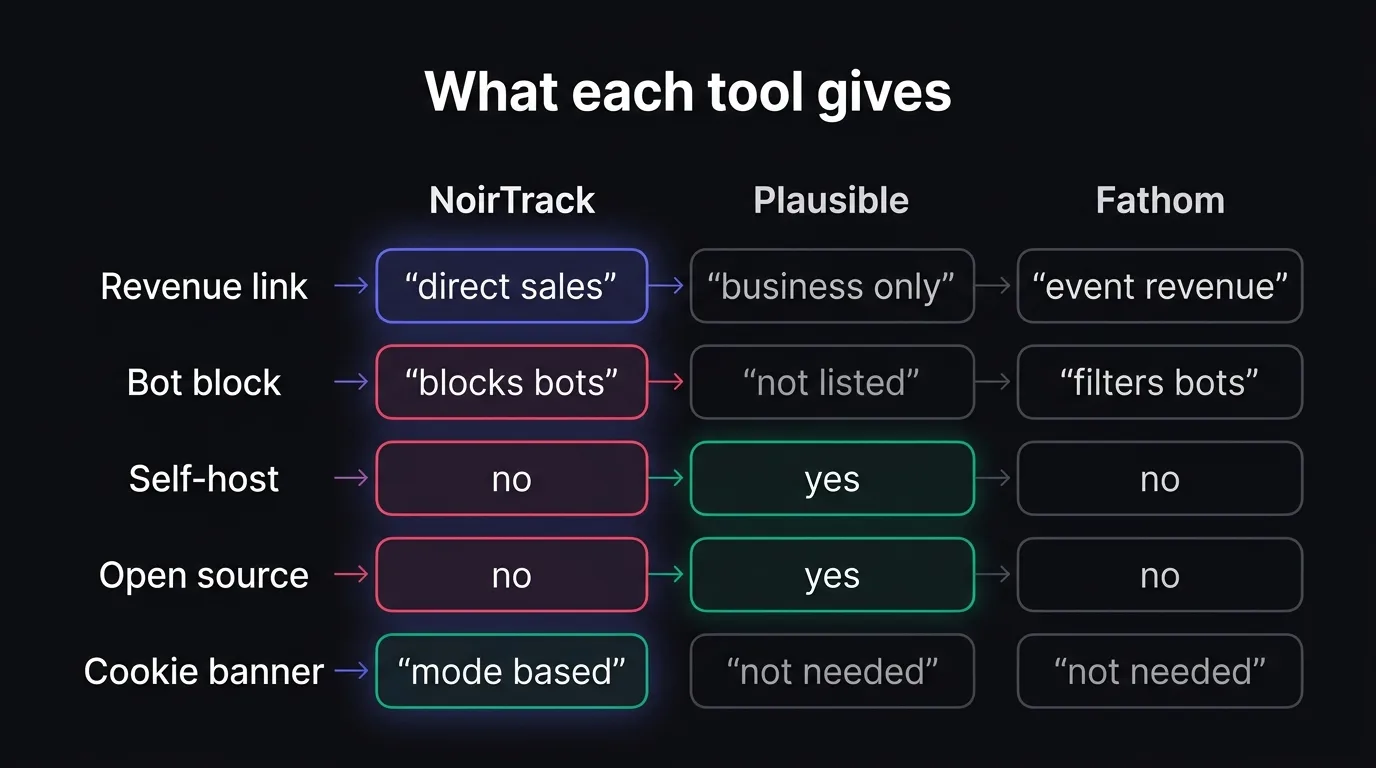
This section compares Plausible alternatives with revenue attribution on the facts that affect a switch: what the starting plan costs, whether sales link back to traffic by default or through custom setup, whether bots get blocked or only filtered in reports, and whether you can self-host the code. Plausible stays in the table so you can see what you gain and what you give up.
Comparison table
| Tool | Starting price | Revenue attribution | Bot handling | Open source or self-hostable |
|---|---|---|---|---|
| NoirTrack | $9/month | Direct | Blocks bots in a firewall | No |
| Plausible | $9/month | Ecommerce revenue attribution on Business | Not listed | Yes |
| Fathom | $15/month | Revenue tracking on all plans | Automatic bot filtering | No |
| Umami | Free hobby plan, $20/month Pro | Revenue tracking on every plan | Not listed | Yes |
| DataFast | $9/month | Integrations with Stripe, LemonSqueezy, Polar and Shopify | Not listed | No |
| PostHog | Usage-based, free allowance included | Not listed | Classifies bot and AI traffic at query time | Yes |
Pricing can be pageview-based or event-based, so the cheapest plan on paper may not stay cheapest as traffic grows. A site with 100,000 pageviews may fit one tool's entry tier, while a product with 1 million events can cross into a higher band sooner.
NoirTrack ties each sale back to the visit, source, and campaign that brought it, and it does that with direct payment provider connections and a /docs/tracking-parameters campaign setup. Plausible remains the cleaner fit if you want open source and self-hosting. Fathom and PostHog both filter or classify bots in reports, but they do not block them before they reach your numbers.
What revenue attribution costs in 2026
Checked on 2026-10-06, the entry price only tells part of the story. A tool can look cheap until revenue tracking sits behind a higher tier, or until you have to wire payment data into checkout code yourself. For buyers comparing Plausible alternatives with revenue attribution, the real question is whether the plan already includes sale matching, or whether you pay later in setup time and plan upgrades.
NoirTrack pricing at a glance
NoirTrack starts at $9 a month on Starter, $19 on Pro, and $49 on Business. Pro includes a 14-day free trial, and NoirTrack does not offer a free plan. Revenue attribution is on every plan, and NoirTrack supports Stripe, Paddle, Polar, Lemon Squeezy, Dodo Payments, and Creem.
That matters because one site can start tracking revenue without buying a higher tier first. A simple setup can look like this in Stripe:
metadata: { visitor_id: noirVid }
That line passes the visitor id into checkout so NoirTrack can match the sale back to the visit that drove it.
When a cheaper-looking tool costs more work
| Tool | Starting price | Revenue attribution | Extra work to watch |
|---|---|---|---|
| Plausible | $9/month | Business plan feature | Revenue tracking sits behind Business, and its pricing page does not list payment provider integrations. |
| Fathom | $15/month | Included on all plans | It includes event and revenue tracking, but does not list direct payment provider integrations or a firewall. |
| Umami | Free self-hosted, Pro $20/month | Included on every plan | It is cheaper for self-hosters, but payment provider integrations are not listed. |
| PostHog | Usage based | Available in a larger product suite | It gives more control, but it asks for more setup and more product decisions. |
Plausible can look like the lowest monthly bill until revenue attribution moves to Business. Fathom keeps revenue tracking on every plan, so the price is easier to read if you already want hosted analytics and do not need direct payment provider links. The cheaper plan is only cheaper when it includes the feature you need on day one.
Where each Plausible alternative is stronger
Pick the tool that fits your setup cost, hosting plan, and how much revenue work you want built in. Some teams want one hosted product that ties sales to traffic and blocks bots before the numbers fill up. Others want open source, self-hosting, or a lighter analytics setup and can accept extra work for attribution. That is the real split in the Plausible alternatives with revenue attribution space.
| Tool | Stronger when you need | Trade-off |
|---|---|---|
| NoirTrack | Hosted analytics with revenue attribution, bot protection, heartbeat uptime and SSL monitoring, and payment-provider connections on every plan | Not open source, no self-hosting |
| Plausible | Open source, EU ownership, cookieless analytics, and reports that stay simple | Revenue attribution starts on Business, and it does not list payment-provider integrations or a firewall |
| Umami | Open source analytics with revenue tracking and funnels, plus self-hosting on the free tier | It does not list payment-provider integrations or a bot-blocking firewall |
| Fathom | Hosted analytics with cookieless tracking, saved views, shared dashboards, and revenue tracking | It does not list funnels, payment-provider integrations, or a bot-blocking firewall |
NoirTrack
NoirTrack fits when you want revenue attribution, bot blocking, and uptime monitoring in one hosted product. It links sales back to the visit that brought them in, and it supports Stripe, Paddle, Polar, Lemon Squeezy, Dodo Payments, and Creem on every plan. A Stripe checkout can pass the visitor id like this:
metadata: { visitor_id: noirVid }
That matters when you want a clean path from ad click to sale without wiring together separate tools. The trade-off is simple too: NoirTrack is not open source and it does not support self-hosting.
It also goes beyond plain site analytics. Pro and Business add surveys, and Business adds session replay and feature flags. If you want those in the same account as revenue and bot controls, NoirTrack is the stronger fit.
Plausible
Plausible is the better pick when open source, EU ownership, and cookieless analytics matter more than direct payment-provider attribution. It includes goals and custom events on all plans, with funnels and ecommerce revenue attribution on Business. It also offers email and Slack reports on all plans.
That makes it a good choice for teams that want a clean dashboard and can work with ecommerce-style revenue reporting instead of Stripe-style payment connections. It is also self-hostable, which some teams need for policy or procurement reasons.
The limit is clear: Plausible does not list Stripe-like payment integrations or a firewall, so attribution-heavy teams usually need more setup or a different tool. If your site sells through a few payment providers and you want those sales tied to traffic automatically, Plausible asks for more manual work.
Umami and Fathom
Umami suits self-hosters who want open source analytics with revenue tracking and funnels. Its free Hobby plan makes it easy to start, and its paid plans add more sites, retention, and higher limits. The trade-off is that it does not list payment-provider integrations like Stripe or a bot-blocking firewall, so attribution depends on your own setup.
Fathom suits teams that want hosted analytics with no cookie banners, saved views, shared dashboards, and revenue tracking. It is a good fit for lean marketing teams that want reporting without much maintenance. It does not list funnels, payment-provider integrations, or a firewall, so it stays lighter and less opinionated about revenue plumbing.
If you want the least setup for paid traffic analysis, NoirTrack is usually the straightest path. If you want open source or self-hosting, Plausible or Umami fit better. If you want hosted analytics with a simpler reporting layer, Fathom makes sense.
How to choose the right tool for your site
Choose the tool that fits this quarter's job, not the one with the longest feature list. If you need revenue attribution, privacy controls, and bot blocking in one place, NoirTrack is the direct fit. If your site only needs cookieless traffic stats and revenue is secondary, Plausible stays simpler. If your team wants self-hosting or a broader product analytics stack, Umami or PostHog can fit better. For a Plausible alternatives with revenue attribution decision, this comes down to payment source, privacy requirements, hosting preference, and bot risk.
-
Name the money source Start with the payment provider you already use. NoirTrack connects to Stripe, Paddle, Polar, Lemon Squeezy, Dodo Payments, and Creem, so a checkout on Stripe can feed revenue back to the visit that started it.
-
Set the privacy bar Decide whether you need cookieless analytics, a consent banner, or self-hosting for policy reasons. Plausible, Fathom, and Simple Analytics all fit teams that want simpler privacy posture. NoirTrack gives you a cookie mode and a cookieless mode, but it is a hosted service, not self-hosted.
-
Check the bot risk If you spend on ads or get scraped a lot, bot blocking matters before attribution does. NoirTrack blocks bots, scrapers, datacenter proxies, VPNs, and AI scrapers before they reach the numbers. Fathom and PostHog filter bots in reports, but they do not block them.
-
Match the hosting model Pick hosted if you want setup done fast. Pick self-hosted only if your team will run the software, handle updates, and own the infrastructure. Plausible and Umami give you that option. NoirTrack and Fathom do not.
A simple decision process
If you run paid acquisition and want to know which source made money, pick NoirTrack. If you want open source, EU hosting, and cookieless analytics, pick Plausible. If you want broader product analytics or you plan to self-host, pick Umami or PostHog.
A simple test helps: if a newsletter click turns into a $120 sale and you need that sale tied back to the source, use the tool that records both the visit and the payment. If you only need to know that the newsletter brought 800 visits, Plausible is enough.
Questions to ask before switching
Ask which payment provider you use, because the tool has to connect to it or accept a checkout-side handoff. Ask whether bot blocking needs to happen before the visit lands, or whether later filtering is acceptable. Ask whether your policy or compliance team needs self-hosting or open source.
Ask one more question: do you need revenue on day one, or can you live without it for now? If revenue is the answer you will check every week, choose the analytics tool that shows it in the same place as traffic.
How to switch from Plausible and keep revenue data
- Create the site. Add the script or SDK for your stack, then wait until visits show up before you connect payments.
- Import old history.
- Connect one payment source. Use /docs/revenue-attribution and, if you take card payments, /docs/stripe to link sales to visits.
- Check source and revenue together. Run a test purchase and confirm the source, campaign, and transaction all match.
First steps after signup
Create the site, add tracking, import Plausible history, then connect payments.
What to verify on day one
Confirm bot traffic stays out of the numbers. Check that a test purchase lands in the transactions view with the right source. Make sure the team knows whether you run cookie mode or cookieless mode.
Questions, answered.
A Plausible alternative with revenue attribution is an analytics tool that connects visits to sales, so you can see which source, campaign, or page generated money. That matters when traffic numbers look fine but sales do not follow. Tools like NoirTrack, Fathom, and Umami all track revenue in different ways, while Plausible adds ecommerce revenue attribution on its Business plan.
In NoirTrack, revenue attribution is included on every plan starting at $9 per month. That makes it part of the core product rather than a paid add on. Other tools may only include revenue tracking on higher tiers or require more setup, so buyers should check whether the plan price covers the attribution they need.
Plausible is open source, EU owned, and cookieless, which makes it a strong pick for teams that want that setup. NoirTrack is privacy first too, but it is a hosted product that adds direct revenue attribution and bot blocking. Teams that want self hosting or public code will usually prefer Plausible, while teams that want attribution and bot blocking in one hosted tool will usually prefer NoirTrack.
Usually yes, because the tool has to connect your payment provider or backend events to the visitor journey. If that connection is missing, you only get visits, not attributed sales. Some tools support direct payment integrations, while others need custom event setup, so switching often means more than pasting a tracking script.
People compare pageview prices and miss whether the tool tracks which visits paid and whether it filters bots in reports. A cheaper plan can cost more if it does not show which visits paid. The right check is whether the tool tracks sales from the sources you already use.
Try NoirTrack
See which traffic actually pays.
Analytics with revenue attribution and a built-in bot firewall. One script tag, live in two minutes.
Free 14-day trial, no credit card
Written by NoirTrack team
The privacy-first Google Analytics alternative with a built-in bot firewall and revenue attribution. See which traffic makes you money, no cookie banner.


